Is It Worth Switching from a Short-Term Rental to a Midterm Rental in Southern California?

If you currently run a short-term rental in Southern California and are wondering whether switching to a midterm rental would make sense, the answer usually comes down to more than which model earns the highest nightly rate.

You also have to consider seasonality, turnover, management workload, vacancy, and what you actually want from the property.

We have managed furnished rentals in Southern California since 2017 and have experience operating both STRs and MTRs.

Both models can work.

They simply create very different rental businesses.

Why STR Owners Start Considering MTRs

STRs can generate strong income, particularly during peak travel periods in Southern California.

That is one of their biggest advantages, and I would never tell an owner to give up a successful STR simply because MTRs are another option.

The tradeoff is the amount of activity required to produce that income.

Shorter reservations usually mean more turnovers, cleaning appointments, pricing adjustments, calendar management, and communication throughout the year.

Income can also be more seasonal.

A property that performs extremely well during stronger travel periods may need a different pricing or booking strategy when demand slows down.

Some owners are perfectly comfortable with that. They enjoy hospitality, have reliable systems in place, and want to maximize the property’s peak-season earning potential.

Others eventually decide that they would rather have longer bookings and fewer turnovers, even if that means giving up some of the upside that STRs can produce during their strongest months.

That is usually where the MTR conversation begins.

What Actually Changes When You Move from STRs to MTRs?

At first glance, the two models look similar.

Both involve furnished properties. Both serve guests rather than traditional long-term renters. Both require active management.

But an MTR is not simply an STR with a 30-day minimum stay.

The guest, booking process, pricing strategy, marketing channels, and day-to-day operation are different.

When you move from STRs to MTRs, several things change:

  • How you price the property
  • Where and how you market it
  • What guests expect from the home
  • How you find potential bookings
  • How you screen guests
  • How often the property turns over
  • How far in advance bookings may be arranged
  • How you manage the relationship once a guest moves in

Understanding those differences is important because simply increasing the minimum stay on an STR listing does not automatically create a successful MTR.

Finding MTR Guests Works Differently

One of the biggest differences is how bookings are found.

STR platforms are generally designed around guests searching for available properties and making reservations through the platform.

MTRs can require a much more proactive approach. In fact, marketing an MTR and securing bookings often takes significantly more hands-on work than getting STR bookings.

Furnished Finder is a good example.

A lot of owners assume Furnished Finder works like a traditional STR booking platform. They create a listing, wait for guests to inquire, and eventually conclude that the platform does not work when very few direct inquiries come in.

That misses a major part of how Furnished Finder operates.

Guests can also post housing requests with information such as:

  • Location
  • Move-in date
  • Length of stay
  • Budget
  • Number of guests
  • Property requirements

Owners can then review those requests and contact guests whose needs match their properties.

There are direct inquiries, matched housing requests, and unmatched housing requests. Across the Furnished Finder listings we manage, direct inquiries represent only a small fraction of the total available leads.

That means successful use of the platform usually requires outreach, not just waiting.

When a property is vacant, or approaching vacancy, reviewing new housing requests and contacting qualified guests becomes part of the leasing process.

MTR platforms have made temporary housing demand easier to find, but somebody still has to consistently find, contact, screen, and convert those leads.

How STR and MTR Income Compare

This is where owners need an honest comparison.

A well-run STR can earn more than an MTR during peak season in Southern California.

That is one of the reasons STRs remain attractive.

Owners can adjust nightly pricing around weekends, holidays, events, seasonal travel, and changing demand. A strong STR in the right location can have a very high income ceiling.

MTRs offer a different income profile.

Instead of building revenue through many nightly or weekly reservations, one guest may book the property for one, two, three, or more months at a time.

You may give up some peak-season earning potential in exchange for longer bookings and fewer turnovers.

That does not automatically make one model more profitable than the other.

You need to compare the entire year.

That means considering:

  • Total rental income
  • Seasonal demand
  • Vacancy
  • Cleaning and turnover expenses
  • Platform fees
  • Utilities
  • Maintenance
  • Management costs
  • Time spent operating the property

Comparing only the nightly rate gives you an incomplete picture.

The real question is:

Which model gives this particular property the best combination of income, workload, and stability over the full year?

Who Actually Books Midterm Rentals?

MTR guests usually need temporary housing for a specific reason.

They are not simply looking for somewhere to spend a weekend.

One important guest profile in Southern California is homeowners who need temporary housing while their own home undergoes major repairs or renovation. Insurance may be involved in covering the housing in some of these situations.

Other guests may include corporate professionals relocating to Southern California, remote workers on extended assignments, or people who need somewhere to live between permanent homes.

These guests are looking for more than a place to sleep.

They may need a full kitchen, laundry, workspace, parking, storage, and enough room to maintain their normal routine.

In other words, they are choosing a temporary home.

That changes the way an MTR needs to be marketed and operated.

MTRs Usually Require Fewer Turnovers

This is one of the clearest operational differences.

If one STR guest stays four nights and an MTR guest stays two months, the number of turnovers required to keep the property occupied changes significantly.

Longer bookings can mean fewer:

  • Check-ins and checkouts
  • Cleaning appointments
  • Property resets
  • Guest onboarding conversations
  • Replenishment visits
  • New reservations to coordinate

But fewer turnovers should not be confused with passive management.

MTRs still require work.

You have to find and screen guests, manage leases and payments, respond to guest questions, coordinate maintenance, adjust pricing, and start looking for the next booking before the current one ends.

In fact, one of the biggest challenges with MTRs is finding and securing bookings. Compared with STRs, MTRs often require much more active marketing, guest outreach, and lead follow-up. Owners cannot simply rely on guests finding their listings and making reservations.

The workload changes rather than disappears.

STRs generally involve more frequent hospitality and turnover work.

MTRs involve fewer turnovers but more active leasing, lead follow-up, and longer guest relationships.

The better question for an owner is not simply, “Which one is less work?”

It is:

Which type of work would I rather manage?

When Switching to MTRs May Make Sense

It may be worth switching from STR to MTR if:

  • You want fewer turnovers throughout the year.
  • Your STR income varies significantly by season.
  • You prefer longer bookings over frequent short reservations.
  • The property fits the needs of temporary housing guests.
  • You want to reduce the hospitality workload associated with frequent turnover.
  • You are willing to actively market the property and pursue leads.
  • Stability matters more to you than maximizing every peak-season night.

The important part is that the decision still needs to be based on the actual property and local demand.

Switching the minimum stay from three nights to 30 nights does not magically turn a property into a good MTR.

When Staying with STRs May Be the Better Decision

There are also plenty of situations where I would tell an owner not to switch.

Staying with STRs may make more sense when:

  • The property already produces strong annual results.
  • The location has consistent short-stay demand.
  • You have reliable cleaning and turnover systems.
  • You are comfortable with frequent turnovers.
  • Maximizing peak-season income is your priority.
  • You enjoy operating the hospitality side of the business.

If you already own a successful STR, there should be a clear reason for changing the model.

“Someone told me MTRs are better” is not a good enough reason.

They are not universally better.

They solve a different problem.

You May Not Have to Choose One Model for the Entire Year

There is also a third option that owners sometimes overlook: the STR/MTR hybrid approach.

STR and MTR strategies do not always have to be mutually exclusive.

Because STRs can produce stronger income during Southern California’s peak periods, some owners may choose to operate shorter stays when demand is strongest and pursue longer MTR bookings during slower periods.

A longer booking during a weak STR season can provide income while also reducing the number of turnovers required during that part of the year.

This is one reason I prefer thinking about STRs and MTRs as different tools rather than competing camps.

The right question is not:

“Which rental model wins?”

It is:

“Which strategy makes the most sense for this property during this period?”

So, Should You Switch from an STR to an MTR?

Start with what you want from the property.

If your priority is maximizing peak-season revenue and you are comfortable managing frequent guest turnover, keeping the property as an STR may make sense.

If you value longer bookings, fewer turnovers, and a less hospitality-intensive operation, MTRs may be worth considering. Just remember that securing MTR bookings often requires more active marketing and follow-up.

And for some properties, using a combination of both models throughout the year may be the stronger strategy.

There is no universal answer.

The right decision depends on the property, the location, current performance, local demand, and what you want the investment to do for you.

Want to Know Which Model Fits Your Property?

If you own a furnished rental in Southern California and are trying to decide whether to continue operating it as an STR, move toward MTRs, or use a combination of both, Hospy Homes can help you evaluate the options.

Our free property assessment looks at the property, its current setup, and the realistic MTR opportunity before recommending a direction.

The goal is not to convince every STR owner to switch.

It is to figure out which rental strategy makes the most sense for your property and your priorities.

Already Running an MTR but Tired of Chasing Leads?

If you own or self-manage an MTR in Southern California and Furnished Finder feels like more work than you expected, that is normal.

Guest sourcing is one of the most active parts of running an MTR well.

At Hospy Homes, we manage the leasing and guest-sourcing process for property owners, including platform leads, screening, communication, and the day-to-day work that comes after the booking.

If you want to know whether professional management would make sense for your property, reach out to Hospy Homes for a free property assessment.

And if you plan to keep self-managing, start with one simple change:

Stop checking Furnished Finder only for new inquiries. Start checking it for new leads.

That is where the opportunity is.

Not Getting Bookings from Furnished Finder? How to use it the right way

If you listed your midterm rental on Furnished Finder, paid the annual fee, and then waited for inquiries to come in, there is a good chance you eventually started wondering:

Does Furnished Finder even work?

This is a common pattern.

Someone puts their property on Furnished Finder. A month goes by. Maybe two or three.

They get very few direct inquiries, sometimes none.

Then they decide the platform was a waste of money.

The problem usually is not Furnished Finder.

The problem is that they are using Furnished Finder like Airbnb.

They are very different platforms.

Across roughly 40 Furnished Finder listings managed by Hospy Homes in Southern California, direct inquiries make up a surprisingly small portion of the available leads.

Once you understand where the rest of those leads are hiding, Furnished Finder starts making a lot more sense.

Airbnb Is a Booking Site. Furnished Finder Is a Listing and Lead Site.

The key difference is how each platform makes money.

Airbnb makes money when a booking happens.

You can list a property for free. Airbnb earns its revenue when a guest actually reserves the property and service fees are collected.

So the platform is designed around getting someone from:

Search → Listing → Booking

Furnished Finder works differently.

You pay to list your property.

Furnished Finder is not processing the entire reservation and payment in the same way Airbnb does. Once you connect with a guest, you generally work out the lease, payment, deposit, and other details directly.

That difference in the business model also changes how people use the platform.

And this is where a lot of MTR owners get confused.

They assume the Furnished Finder experience should look something like this:

Guest searches → Finds your property → Messages you → Books

That can happen.

But it is only one part of the platform.

The Best Way to Think About Furnished Finder Is Like Classifieds

Think of it this way.

Furnished Finder is more like the classified section of a newspaper, or Craigslist in the basic sense that people can both offer something and ask for something.

As an owner, you are offering:

“I have a furnished property available in Long Beach from June through September.”

But guests can also post:

“I need a furnished one-bedroom in Long Beach starting June 15, my budget is X, and I need parking.”

That is a completely different dynamic.

The guest does not necessarily have to find your listing.

They can post a Housing Request, and you can reach out to them. Here’s exactly how the Housing Request form looks on Furnished Finder’s website: https://www.furnishedfinder.com/housing-request

That is why one of the most important sections of Furnished Finder is the section called Tenant Leads.

That name is Furnished Finder’s terminology. In practice, think of it as your lead pipeline. Housing Requests that match your property will show up in this section.

And if you are only waiting for people to contact your listing directly, you are ignoring most of that pipeline.

There Are Three Types of Furnished Finder Leads

Understanding these lead types helps you make better use of your listing.

There are basically three categories.

1. Direct inquiries

This is what most owners are waiting for.

Someone searches Furnished Finder, finds your specific property, likes it, and sends you a message.

Maybe they ask:

“Is this available?”

“What’s the parking situation?”

“Would you accept my dog?”

These are great leads because the guest has already looked at your property and shown interest.

So yes, respond quickly.

The problem is that there are not very many of them.

In the Hospy Homes account used for this example, roughly 40 Furnished Finder listings received only three direct inquiries during approximately a six-week period.

Think about that.

Forty listings.

Three direct inquiries.

If you only have one property, it would be completely normal to go several weeks, or even longer, without receiving one.

That does not mean nobody is looking for housing.

It means you are looking at only one type of lead.

2. Matched housing requests

This is where things become much more interesting.

A guest can tell Furnished Finder what they are looking for:

  • City
  • Move-in date
  • Length of stay
  • Budget
  • Number of guests
  • Bedroom requirement
  • Other property needs

Furnished Finder then compares that request with your listings.

If the request matches one of your properties, it can appear as a matched housing request.

The important difference is this:

They have not necessarily contacted you.

You contact them.

You can reach out and say, essentially:

“I saw your housing request. I have a property that appears to match what you’re looking for. Here are the details.”

That is much closer to sales outreach than waiting for an Airbnb reservation.

And there are far more of these leads.

In that same Furnished Finder account, there were roughly 10 matched housing requests in about five to six days, compared with only three direct inquiries across about six weeks.

That is a very different picture.

3. Unmatched housing requests

Then there is the largest category.

Unmatched requests.

These are guests looking for housing in your area, but at least one detail does not line up perfectly with your property.

Maybe they need a pet-friendly property and yours says no pets.

Maybe their budget is different.

Maybe their dates are slightly off.

Maybe they requested a feature you do not have.

These leads have a lower chance of turning into a booking.

But lower does not mean zero.

In the same example, there were roughly 14 unmatched housing requests in one day.

Compare that with three direct inquiries in six weeks.

That is why owners should not ignore this section.

You obviously should not contact every person blindly.

If their budget is nowhere near your rate, move on.

If they need four bedrooms and you have one, probably move on.

But sometimes the mismatch is negotiable.

Maybe they say they have a small dog and you are willing to make an exception for the right booking.

Maybe their move-in date can shift.

Maybe you have another property nearby that fits them better.

You will never know if you do not start the conversation.

Most Furnished Finder Owners Are Waiting for the Smallest Bucket

This is really the point of the entire article.

A lot of owners judge Furnished Finder based almost entirely on direct inquiries.

In the example from the Hospy Homes account, direct inquiries represented a small share of the available leads.

That is a huge difference.

Imagine a salesperson complaining that they have no customers while ignoring almost every lead sitting in their CRM.

That is basically what happens when an owner lists on Furnished Finder and waits.

Furnished Finder works best when you treat it like a lead-generation platform.

Not a vending machine where you insert a listing and bookings fall out.

What Should You Actually Do When Your Property Is Vacant?

If your property is sitting vacant right now, Furnished Finder should become part of your daily routine.

Start with three things.

First, respond to every legitimate direct inquiry as quickly as possible.

Those are your highest-intent leads.

Second, review your matched housing requests and contact the ones that fit.

These guests have already told Furnished Finder that their dates, location, budget, and other criteria align with your property.

Third, scan the unmatched requests.

Do not spend all day on them.

Look for situations where the mismatch is small enough that the booking could still work.

The goal is not to chase every person on the platform.

The goal is to stop waiting passively for someone to discover you.

When your property is vacant, every additional day without a booking is lost income.

That makes proactive outreach worth the effort.

Start Looking Before Your Current Guest Leaves

Another common mistake is waiting too long.

Owners wait until the property is empty before they start trying to fill it again.

You do not necessarily have to.

Some Furnished Finder guests start looking months before they need housing.

In the account used for this example, guests were submitting requests several months ahead of their planned move-in dates.

If you have a guest leaving soon, start working the leads roughly three to four weeks before the upcoming vacancy.

Sometimes you can have the next booking lined up before the current guest ever checks out.

That is a much better position to be in than staring at an empty calendar after the property becomes vacant.

A Simple Trick if You Manage More Than One Property

There is one small Furnished Finder trick that can save you some confusion.

When Furnished Finder matches a housing request with one of your properties, it may show you the property’s ID number rather than a name that is immediately recognizable.

If you manage multiple properties, you probably do not have all those ID numbers memorized.

The property URL can help.

You can copy the property ID and enter it at the end of the Furnished Finder property URL.

That will pull up the listing Furnished Finder matched with the request.

Then you can decide whether that property makes sense, or whether you have another nearby property that might be an even better fit.

Small thing, but useful when you are working through a lot of leads.

Furnished Finder Is Not Passive

Set this expectation before getting into MTRs.

Putting a property on Furnished Finder is not the strategy.

It is one part of the strategy.

If you are self-managing, someone still has to:

Find the leads.

Review them.

Reach out.

Follow up.

Answer questions.

Screen the guest.

Agree on the terms.

Handle the lease.

Collect payment.

And manage the stay.

That is not necessarily bad.

But you should know what business you are signing up for.

MTRs generally have fewer turnovers than STRs, but getting those longer bookings can require more proactive leasing work.

That is the trade.

So, Does Furnished Finder Work?

Yes.

But not if you use it like Airbnb.

If your entire Furnished Finder strategy is:

List the property → Wait → Hope someone reaches out

you are leaving a lot of opportunity untouched.

The owners who get more value from Furnished Finder understand that it is a marketplace for leads, not just listings.

They respond to direct inquiries.

They work matched housing requests.

They selectively pursue unmatched requests.

And when the property is vacant, they do it consistently.

That is the real lesson.

Furnished Finder is not necessarily failing you.

You may just be waiting for the wrong part of the platform to do all the work.

Already Running an MTR but Tired of Chasing Leads?

If you own or self-manage an MTR in Southern California and Furnished Finder feels like more work than you expected, that is normal.

Guest sourcing is one of the most active parts of running an MTR well.

At Hospy Homes, we manage the leasing and guest-sourcing process for property owners, including platform leads, screening, communication, and the day-to-day work that comes after the booking.

If you want to know whether professional management would make sense for your property, reach out to Hospy Homes for a free property assessment.

And if you plan to keep self-managing, start with one simple change:

Stop checking Furnished Finder only for new inquiries. Start checking it for new leads.

That is where the opportunity is.

Converting a Long-Term Rental to a Midterm Rental in Southern California: What Actually Changes

If you own a long-term rental in Southern California and you are wondering whether the same property could earn more as a midterm rental, this is one of the most important questions to understand before making the switch.

We’ve been managing furnished rentals in Southern California since 2017, and this comes up often with property owners who are evaluating their options.

Usually, there is no grand plan to become an MTR owner.

A lease ends. The property becomes available. The owner looks at the long-term rental rate and starts wondering whether there is another way to use the property.

The income potential is often what starts the conversation, but converting from a long-term rental to an MTR changes more than the monthly rent.

Your income model changes. Your guests change. The property needs to be furnished. Marketing becomes more active. There is more management involved. And yes, vacancy becomes a different type of risk.

Here is what Southern California property owners should realistically expect.

The first thing most owners worry about is vacancy

A 12-month lease feels predictable.

Once the property is occupied, you generally know what rent is coming in every month until the lease ends.

MTRs work differently. Guests stay for 30 days or longer, but you may have multiple bookings throughout the year rather than one person occupying the property under a traditional annual lease.

That naturally creates a concern:

What if I earn a higher monthly rate but spend too much time vacant between bookings?

That is the right question to ask.

The mistake is assuming either extreme, that MTRs automatically eliminate vacancy or that shorter leases automatically make them too risky.

Vacancy is a real part of the MTR equation. Before converting, you have to look at whether there is enough temporary housing demand around the property to justify the higher rate and additional operating costs.

This is why we do not believe every Southern California property should automatically become an MTR.

The numbers still have to make sense.

What changes about your income

This is usually the biggest reason long-term rental owners start considering MTRs.

For the Southern California properties we work with, a well-run MTR can generally earn around 1.5x to 2x the long-term rental rate.

That does not mean every property will hit the top of that range. The actual result depends on the property, location, setup, local demand, pricing, and how well it is managed.

But it changes the economics considerably.

With a long-term rental, your income is largely tied to the market rent for that property. There is only so far above comparable long-term rentals you can reasonably price it.

With an MTR, you are offering something different: a furnished home, flexible stay length, utilities and household necessities, and temporary housing for guests who may not be looking for a traditional lease.

That allows the property to command a higher monthly rate.

The important distinction is that the higher rate does not make vacancy irrelevant.

You still need to account for vacancy, furnishing costs, utilities, maintenance, management, and other operating expenses when comparing the two models.

The question is not simply, “Which one has a higher monthly rate?”

The better question is:

Which model produces the better overall return for this specific property, after accounting for the additional costs and work involved?

Who actually stays in an MTR?

Another major change is the guest.

MTR guests usually are not looking for a weekend getaway. They need temporary housing that functions like a real home.

One important guest profile we see is homeowners who need somewhere to live while their own home is undergoing major repairs or renovation. In some situations, insurance is involved in covering their temporary housing.

Corporate relocators are another common guest profile. Someone may be moving into Southern California for work but need furnished housing while they transition into a permanent home.

Other MTR guests can include remote workers on extended stays and people between permanent homes or going through a life transition.

What connects these guests is that they need flexibility without committing to a traditional 12-month lease.

That difference matters because you are no longer simply putting a rental on the market and waiting for someone who wants to live there for the next year.

You are solving a temporary housing problem.

That changes how the property is positioned, where it is marketed, how inquiries are handled, and what guests expect from the home.

The property itself has to change

The physical property usually needs more preparation than an LTR.

An MTR needs to function as a furnished home from the moment the guest arrives.

That means furniture, beds, kitchen equipment, household essentials, reliable internet, and the other basics someone needs to comfortably live there for an extended period.

This is an upfront investment that LTR owners sometimes underestimate.

And furnishing alone is not enough.

The property also needs to be marketed appropriately for furnished stays, photographed professionally, listed on the right platforms, priced correctly, and prepared for guest turnover.

At Hospy Homes, the management process can include property assessment, setup and furnishing guidance, professional listing creation, guest sourcing and screening, guest communication, maintenance coordination, reporting, and ongoing pricing optimization.

So while the same physical house may be used, you are essentially operating it as a different rental product.

Management becomes more active

This is one of the tradeoffs owners need to understand clearly.

An MTR usually takes more management than a traditional long-term rental.

You may have several guests throughout the year instead of one lease. That means more inquiries, more screening, more communication, more move-ins and move-outs, and more opportunities for maintenance issues to come up between stays.

Finding bookings is also different.

For example, Furnished Finder does not work like a traditional booking platform where an owner can simply create a listing and expect reservations to arrive automatically.

There are direct inquiries, but there are also housing requests that owners need to pursue proactively. When one of our properties is approaching vacancy, outreach becomes part of the leasing process.

This is where some long-term rental owners underestimate the conversion.

They compare the higher MTR rate to their current LTR rate, but they do not compare the operational workload.

The income opportunity is higher, but somebody still has to do the work required to produce that income.

That does not mean you have to self-manage it

This is where the economics can become interesting for LTR owners.

Normally, buying back your time costs money.

You hire someone to do work you were previously doing yourself, so your expenses increase and your profit decreases.

Converting an LTR to an MTR can create a different situation.

Because MTRs can earn around 1.5x to 2x the long-term rental rate in Southern California, there are properties where an owner can pay for professional management, remove most of the day-to-day work from their plate, and still come out ahead compared with keeping the property as an LTR.

That is one of the biggest reasons I think the LTR-to-MTR conversion is worth evaluating.

It is not simply about earning more.

For the right property, it can be about earning more while doing less yourself.

Of course, that only works when the underlying property performs well enough to support the additional expenses. A management company cannot fix a property that does not have the right economics or demand in the first place.

So, should every long-term rental owner switch to MTRs?

No.

And I would be skeptical of anyone who tells you otherwise.

Some properties are better suited for traditional long-term rentals. Others may work better as STRs. Some properties are excellent candidates for MTRs.

The decision depends on several things:

  • The long-term rental rate you could currently receive
  • Temporary housing demand around the property
  • The cost of furnishing and preparing the home
  • The type of property and its location
  • Expected operating expenses
  • How actively the property will be managed
  • Your own goals for income, flexibility, and involvement

This is also why Hospy Homes does not take on every property that comes our way. We want to understand whether we believe the property can actually perform before recommending the model.

A higher advertised monthly rate is not enough reason to convert.

You need to understand the full business behind that rate.

The real difference between an LTR and an MTR

If you are currently running a long-term rental, converting it into an MTR is not just changing the lease from 12 months to 30 or 60 days.

You are changing the entire operating model.

You are exchanging some of the simplicity and predictability of an LTR for higher income potential and greater flexibility.

In return, you take on furnishing costs, more active booking management, guest communication, and the possibility of vacancy between stays.

For the right Southern California property, that trade can make a lot of sense.

For the wrong one, it may not.

The goal should not be to convert because MTRs sound more profitable.

The goal should be to look at your specific property, understand the realistic income opportunity and expenses, and determine which rental model gets you closer to what you actually want from the investment.

Not sure if your property makes sense as an MTR?

If you own a long-term rental in Southern California and you are trying to determine whether converting it into an MTR would actually improve the numbers, we are happy to take a look with you.

Hospy Homes offers a free property assessment where we evaluate the property, the local MTR opportunity, and what the economics could realistically look like.

There is no point forcing a property into a rental model that does not fit.

But if the numbers work, converting from an LTR to an MTR can give property owners something that is difficult to find in real estate: the opportunity to increase income while also buying back their time.

Ready to See What Your Property Could Do as an MTR?

If you own a property in Southern California and want to understand whether professional midterm rental management makes sense for you, let’s take a look at it together.

Tell us about your property, and the Hospy Homes team will reach out within one business day to discuss your goals, your property’s potential, and how we may be able to help.

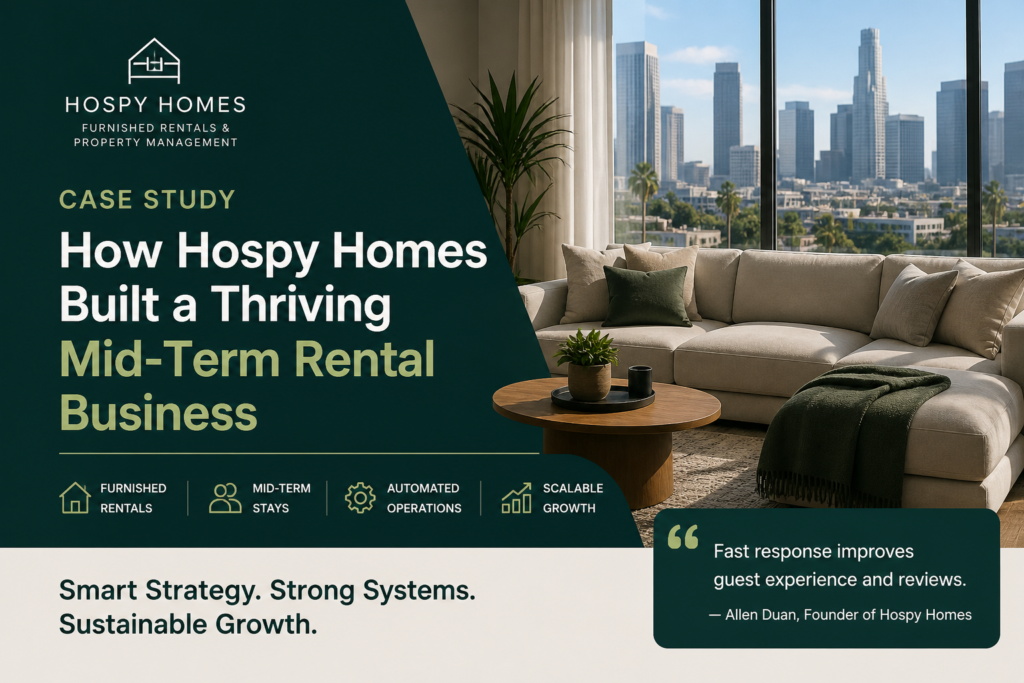
How Hospy Homes Built a Thriving Mid-Term Rental Business (Real Case Study)

Introduction

The mid-term rental market is quietly becoming one of the most profitable opportunities in real estate today.

While many property owners are still focused on short-term rentals like Airbnb, smart operators are shifting toward mid-term rentals—especially in cities like Los Angeles and Dallas-Fort Worth.

Hospy Homes is one of the companies leading this shift.

In this case study, we’ll break down how Hospy Homes built a thriving rental business, what strategies they used, and what property owners can learn from it.

Who Is Behind Hospy Homes?

Hospy Homes is led by Allen Duan, a real estate operator who built a scalable rental management business focused on furnished rentals.

Instead of managing properties the traditional way, Hospy Homes focuses on:

  • Mid-term rentals (30+ day stays)
  • Furnished rental management
  • Co-hosting for property owners

This approach allows them to serve both guests and property owners efficiently.

Why Mid-Term Rentals Work So Well

Mid-term rentals (MTR) are typically stays between 30 to 90 days.

👉 Compared to short-term rentals:

  • Less strict regulations
  • Fewer turnovers
  • More stable monthly income

👉 Compared to long-term rentals:

  • Higher earning potential
  • More flexibility

That’s why Hospy Homes focused heavily on this model.

Growth of Hospy Homes

Hospy Homes started small but quickly scaled by focusing on systems instead of manual work.

Today, they manage multiple properties across:

  • Los Angeles
  • Southern California
  • Expanding into Dallas-Fort Worth

Their growth is driven by consistency, automation, and a clear strategy.

The Secret: Systems & Automation

One of the biggest reasons behind their success is automation.

Managing multiple properties manually is not scalable.

Hospy Homes uses systems to handle:

  • Guest communication
  • Booking management
  • Check-in coordination
  • Support responses

👉 Result:

✔ Faster response times
✔ Better guest experience
✔ Higher ratings
✔ More bookings

A Smarter Property Management Approach

Most property managers focus only on listings.

Hospy Homes focuses on the entire system:

  • Pricing strategy
  • Guest experience
  • Operational efficiency
  • Property performance

This gives property owners a hands-off experience while maximizing revenue.

What Property Owners Can Learn

If you own a property in Los Angeles or Dallas, here are key takeaways:

1. Mid-Term Rentals Are the Future

Demand is growing for furnished, flexible stays—especially for professionals and relocations.

2. Systems Beat Manual Work

Without automation, scaling becomes impossible.

3. Guest Experience Drives Revenue

Better reviews = more bookings = higher income.

4. Location Still Matters

Markets like Dallas-Fort Worth are growing fast for furnished rentals.

Why This Matters for Dallas-Fort Worth

Hospy Homes is expanding into the Dallas market—and for good reason.

👉 Dallas offers:

  • Growing population
  • Strong corporate relocation demand
  • Increasing need for furnished housing

This makes it one of the best markets for mid-term rentals right now.

Final Thoughts

Hospy Homes proves that you don’t need hundreds of properties to build a successful rental business.

You need:

The right strategy + strong systems + consistent execution

That’s what turns a simple rental into a scalable business.

🚀 Want Help Managing Your Rental?

If you’re a property owner looking to increase your rental income without handling the day-to-day work:

👉 Hospy Homes can help.


Get Started →